Interview Questions Message
The Interview Questions Message provides you with potential interview questions tailored to the specific job you're applying for, helping you prepare effectively for your interview.
What Is This Message?
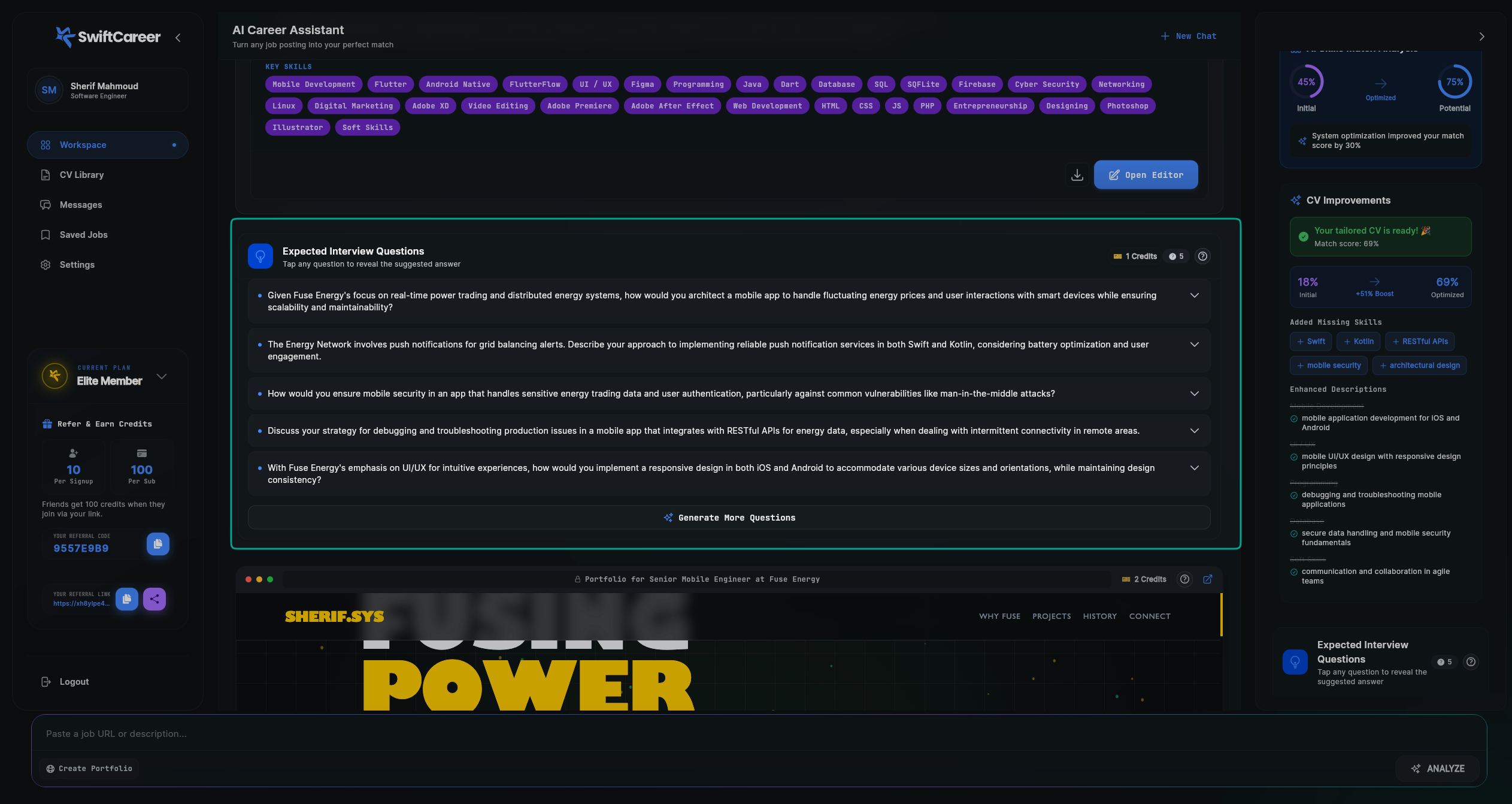
The Interview Questions Message includes:
- Job-specific questions: Questions likely to be asked for this role
- Technical questions: Questions about skills and technologies mentioned in the job
- Behavioral questions: Common interview questions adapted to the role
- Preparation tips: Guidance on how to answer effectively
This message helps you prepare thoroughly for your interview by giving you insight into what you might be asked and how to structure your answers.
Message Components
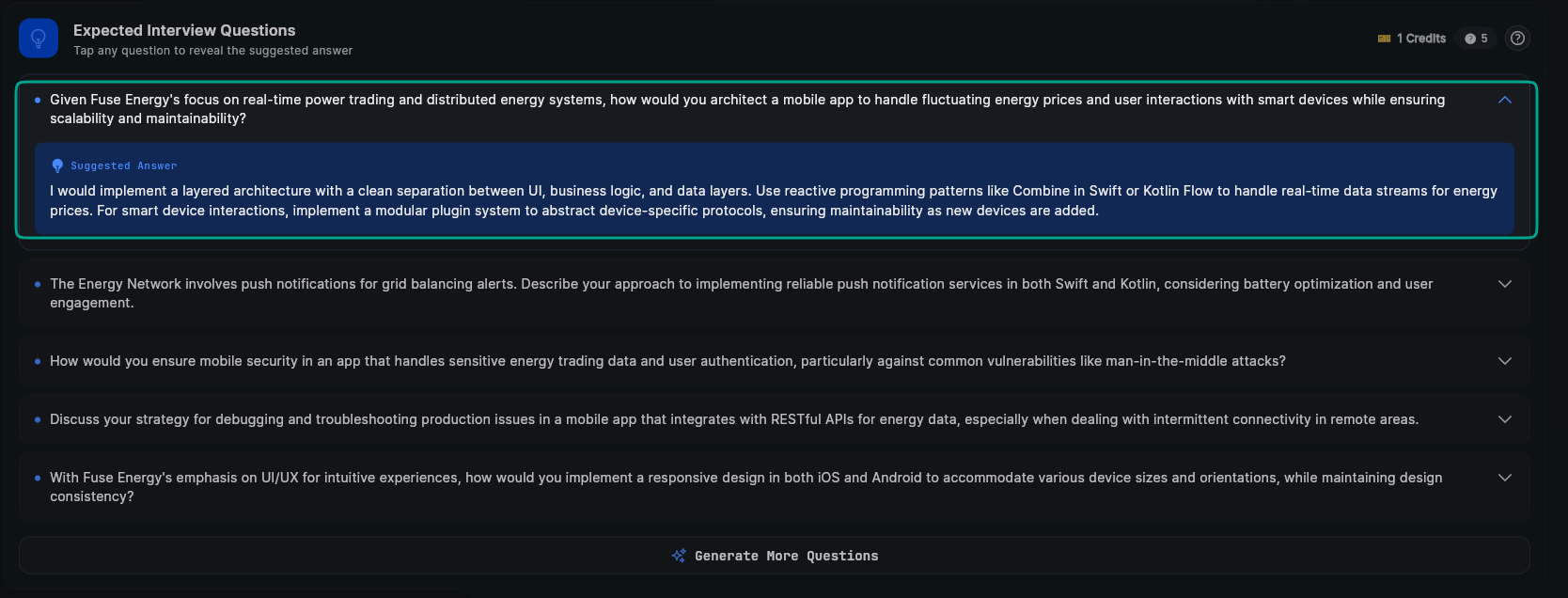
1. Technical Questions Section
Role-Specific Questions
- Questions about technologies mentioned in the job
- Example: "Explain how you would implement state management in Flutter"
- Based on required skills from job posting
Skill-Based Questions
- Questions about specific skills required
- Example: "Describe your experience with REST APIs"
- Tailored to your profile and job requirements
Problem-Solving Questions
- Technical challenges you might face
- Example: "How would you optimize app performance?"
- Real-world scenarios
3. Behavioral Questions Section
STAR Method Questions
- Situation, Task, Action, Result format questions
- Example: "Tell me about a time you faced a difficult technical challenge"
- Common behavioral interview questions
Teamwork Questions
- Questions about collaboration and teamwork
- Example: "Describe a time you worked with a difficult team member"
- Based on soft skills mentioned in job
Leadership Questions (if applicable)
- Questions about leading projects or teams
- Example: "Tell me about a time you had to lead a project"
- For senior or lead positions
4. Company-Specific Questions
About the Company
- Questions you might be asked about the company
- Example: "Why do you want to work here?"
- Shows you should research the company
About the Role
- Questions about your interest in the specific role
- Example: "What interests you about this position?"
- Helps you articulate your motivation
5. Questions to Ask Them
Smart Questions
- Questions you should ask the interviewer
- Example: "What does success look like in this role?"
- Shows your interest and helps you evaluate the role
Company Culture Questions
- Questions about work environment
- Example: "How does the team collaborate?"
- Helps you assess fit
6. Answering Tips
STAR Method Guide
- How to structure behavioral answers
- Situation, Task, Action, Result framework
- Examples of good answers
Technical Answer Tips
- How to explain technical concepts clearly
- How to demonstrate your knowledge
- How to handle questions you don't know
General Tips
- Body language and communication
- How to handle difficult questions
- What to avoid saying
How to Use It
Step 1: Review All Questions
- Read through: Familiarize yourself with all questions
- Identify patterns: Notice common themes
- Prioritize: Focus on questions most relevant to the role
- Note gaps: Identify areas where you need to prepare more
Step 2: Prepare Your Answers
- Use STAR method: For behavioral questions, structure answers clearly
- Be specific: Use real examples from your experience
- Practice out loud: Say your answers to get comfortable
- Time yourself: Keep answers concise (2-3 minutes)
Step 3: Research Technical Topics
- Review technologies: Brush up on skills mentioned in questions
- Study concepts: Understand key technical concepts
- Prepare examples: Have specific projects or experiences ready
- Practice explanations: Be able to explain clearly
Step 4: Prepare Questions to Ask
- Select 3-5 questions: Choose questions you genuinely want answered
- Research company: Make questions company-specific
- Show interest: Ask about growth, culture, or projects
- Avoid basic questions: Don't ask things easily found online
Step 5: Practice Your Answers
- Practice out loud: Say answers multiple times
- Record yourself: Listen for clarity and flow
- Get feedback: Practice with a friend or mentor
- Refine: Improve answers based on practice
Step 6: Review Before Interview
- Quick review: Go through questions one more time
- Refresh memory: Remind yourself of key points
- Stay calm: Remember you're prepared
- Be authentic: Answer honestly and naturally
Important Tips
Answering Behavioral Questions
Use STAR Method:
- Situation: Set the context
- Task: What you needed to accomplish
- Action: What you specifically did
- Result: What happened and what you learned
Example:
Situation: "In my previous role, we had a critical bug affecting 10,000 users."
Task: "I needed to identify and fix the issue quickly."
Action: "I analyzed the logs, identified the root cause, and implemented a fix within 2 hours."
Result: "The bug was resolved, and I implemented monitoring to prevent similar issues."
Answering Technical Questions
Be Clear:
- Explain concepts in simple terms
- Use examples when possible
- Show your thought process
- Admit if you don't know something
Show Knowledge:
- Reference specific technologies
- Mention relevant experience
- Discuss best practices
- Show continuous learning
What to Avoid
- Rambling: Keep answers focused and concise
- Negative comments: Don't criticize previous employers
- False claims: Don't claim experience you don't have
- Being unprepared: Show you've done your research
- Not asking questions: Always have questions ready
Handling Difficult Questions
If You Don't Know:
- Be honest: "I haven't worked with that specific technology, but..."
- Show willingness to learn: "I'm eager to learn and have experience with similar tools"
- Relate to experience: "While I haven't used X, I have experience with Y which is similar"
If Asked About Weaknesses:
- Choose a real but minor weakness
- Show how you're working on it
- Frame it positively: "I'm working on improving my time management by..."
Practical Example
Here's what an Interview Questions Message might look like:
❓ Interview Questions - Senior Flutter Developer

Job: Senior Flutter Developer at Tech Innovations Inc.

TECHNICAL QUESTIONS:

1. "Explain your experience with Flutter state management. Which solutions have you used and why?"

2. "Describe a challenging Flutter project you worked on. What problems did you face and how did you solve them?"

3. "How do you handle app performance optimization in Flutter?"

4. "Walk me through your experience with REST APIs and how you handle API integration in Flutter apps."

5. "What's your approach to testing Flutter applications?"

BEHAVIORAL QUESTIONS:

1. "Tell me about a time you had to learn a new technology quickly for a project."

2. "Describe a situation where you had to work with a difficult team member. How did you handle it?"

3. "Give me an example of a project where you had to meet a tight deadline. How did you manage it?"

4. "Tell me about a time you made a mistake in your code. How did you handle it?"

5. "Describe a situation where you had to mentor or help a junior developer."

QUESTIONS TO ASK THEM:

1. "What does a typical day look like for a Senior Flutter Developer on your team?"

2. "What are the biggest technical challenges the mobile team is currently facing?"

3. "How does the team approach code reviews and knowledge sharing?"

4. "What opportunities are there for professional growth and learning?"

5. "What projects is the team most excited about working on?"

💡 TIPS:

- Use STAR method for behavioral questions
- Be specific with technical examples
- Show enthusiasm and willingness to learn
- Ask thoughtful questions about the role and company
What to do with this:
- Review questions: Read through all questions carefully
- Prepare answers: Write out answers using STAR method
- Practice: Say answers out loud multiple times
- Research: Brush up on any technical topics you're unsure about
- Prepare questions: Select 3-5 questions to ask them
Additional Example: Quality Manager in Manufacturing
Here's another example for a Quality Manager position in a manufacturing plant:
❓ Interview Questions - Quality Manager

Job: Quality Manager at Industrial Manufacturing Co.

TECHNICAL QUESTIONS:

1. "How do you ensure product quality standards are met throughout the manufacturing process?"

2. "Describe your experience with ISO 9001 quality management systems."

3. "How do you handle quality control when dealing with suppliers and raw materials?"

4. "What quality metrics do you track, and how do you use them to improve processes?"

5. "Walk me through how you would investigate and resolve a quality issue that affects production."

BEHAVIORAL QUESTIONS:

1. "Tell me about a time you had to implement a new quality standard across the entire production line."

2. "Describe a situation where you discovered a quality issue that could have caused significant problems. How did you handle it?"

3. "Give me an example of how you've improved quality processes while maintaining production efficiency."

4. "Tell me about a time you had to work with production managers who were resistant to quality changes."

5. "Describe a situation where you had to make a difficult decision regarding product quality versus production deadlines."

QUESTIONS TO ASK THEM:

1. "What are the current quality challenges the manufacturing facility is facing?"

2. "How does the quality department collaborate with production and engineering teams?"

3. "What quality certifications does the company hold, and are there plans to pursue additional ones?"

4. "What opportunities are there for continuous improvement in quality processes?"

5. "How does the company handle quality training and development for staff?"
Example Answers
Question 1: "How do you ensure product quality standards are met throughout the manufacturing process?"
Example Answer: "I implement a multi-layered quality assurance approach. First, I establish clear quality checkpoints at critical stages of production - incoming materials, in-process inspection, and final product testing. I work with production teams to create standard operating procedures (SOPs) that include quality criteria. I also conduct regular audits and use statistical process control to monitor quality trends. For example, in my previous role, I implemented a real-time quality monitoring system that reduced defects by 35% within six months by catching issues early in the production line."
Question 2: "Describe your experience with ISO 9001 quality management systems."
Example Answer: "I have extensive experience with ISO 9001. In my last position, I led the company's ISO 9001:2015 certification process. I developed all required documentation, including quality manuals, procedures, and work instructions. I trained staff on quality management principles and conducted internal audits. We successfully achieved certification and maintained it through annual audits. The system helped us reduce customer complaints by 40% and improve our overall process efficiency."
Question 3: "Tell me about a time you discovered a quality issue that could have caused significant problems. How did you handle it?"
Example Answer (STAR Method):
- Situation: "During a routine quality audit, I discovered that a batch of raw materials didn't meet our specifications, but had already been used in production."
- Task: "I needed to prevent potentially defective products from reaching customers while minimizing production disruption."
- Action: "I immediately halted production of that batch, quarantined all affected products, and conducted thorough testing. I worked with the supplier to investigate the root cause and implemented stricter incoming inspection procedures. I also developed a traceability system to quickly identify affected products in the future."
- Result: "We prevented defective products from shipping, strengthened our supplier quality controls, and the new traceability system helped us respond 50% faster to similar issues. The supplier also improved their quality processes as a result."
Question 4: "How do you handle quality control when dealing with suppliers and raw materials?"
Example Answer: "I establish clear quality agreements with suppliers that specify acceptance criteria, testing requirements, and documentation needs. I conduct supplier audits to assess their quality systems and capabilities. For incoming materials, I implement a sampling plan based on risk assessment - critical materials get 100% inspection, while lower-risk items use statistical sampling. I also maintain a supplier scorecard tracking quality metrics like defect rates, on-time delivery, and corrective action response times. When issues arise, I work collaboratively with suppliers on root cause analysis and continuous improvement, rather than just rejecting materials."
Question 5: "Give me an example of how you've improved quality processes while maintaining production efficiency."
Example Answer: "In my previous role, production was experiencing bottlenecks at the final inspection stage. I analyzed the process and found that 60% of defects were recurring issues that could be prevented earlier. I implemented a 'quality at source' program where operators performed self-inspection at their workstations using simple checklists and visual aids. I also moved some inspection points upstream in the process. This reduced final inspection time by 45% and actually improved overall quality because issues were caught and fixed immediately. Production efficiency increased, and we reduced rework costs by 30%."
Next Steps
After reviewing the Interview Questions:
- Practice Your Answers - Prepare thoroughly
- Review Your CV - Refresh your memory on your experience
- Research the Company - Learn more about the company
Getting Help
- Review FAQ
- Contact support via swiftcareer.io